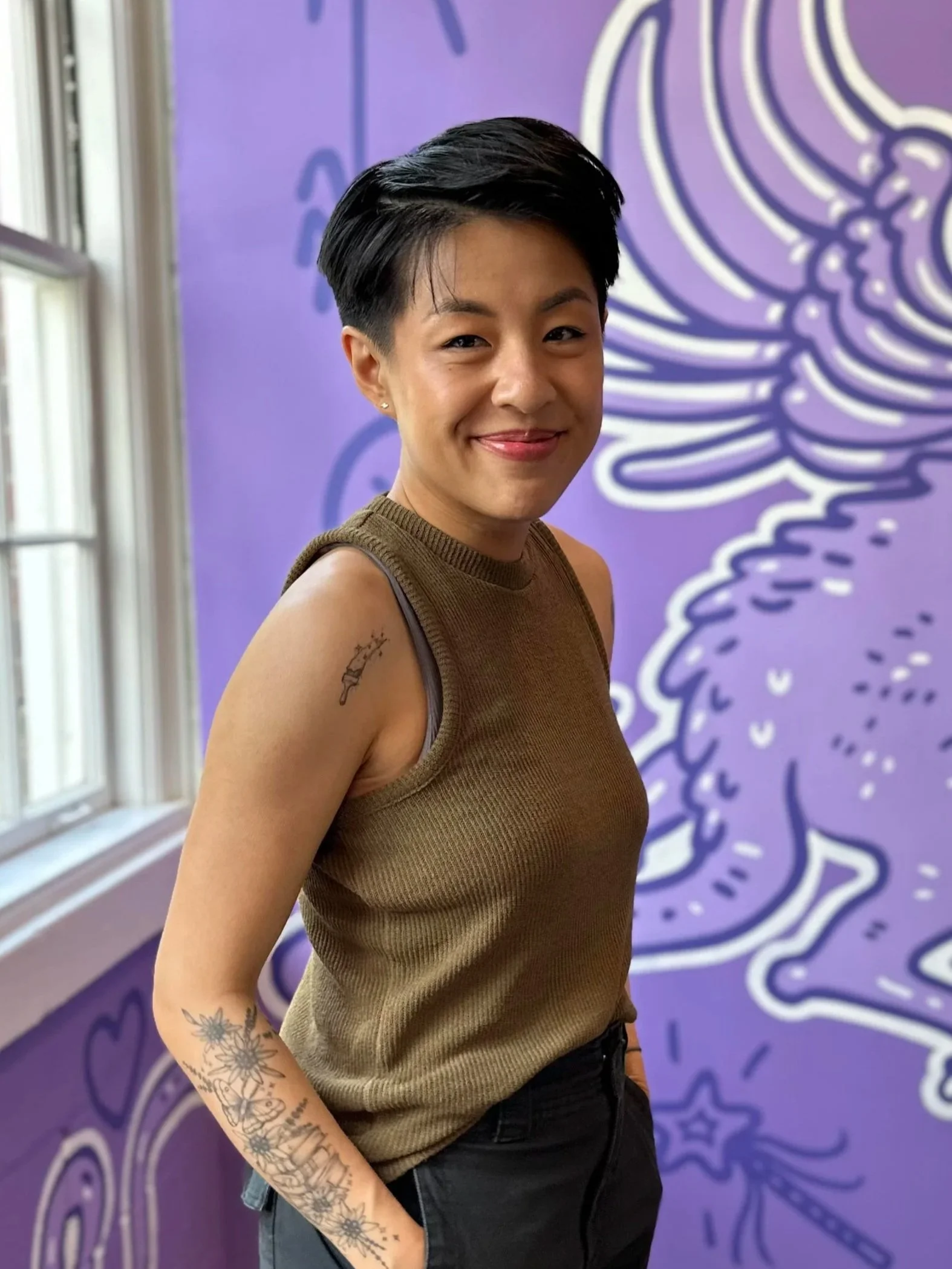
hi! i’m jocelyn (they/them).
I am an AuDHD, queer, non-binary, 2nd generation Chinese-Canadian immigrant living in the Bay Area of California. The intersection of these identities and growing up in an overwhelmingly White, conservative part of Canada informed my experience of feeling simultaneously not enough and too much. As well, my experience with severe postpartum depression and infant feeding allowed me to question everything I had learned from social and transgenerational messages about what it means to be a “good mother” and to have a “good body.” I set my intention to work with folks who live in these intersections and phases of life, to navigate the oppressive structures that prevent us from expressing ourselves authentically.
how i work
My theoretical orientations are primarily Internal Family Systems Informed, Narrative Therapy, and Relational-Cultural Therapy.
IFS helps to understand protective parts shaped by trauma and engage in inner child work without shaming the mechanisms you used to survive.
Narrative therapy allows us opportunity to loosen repetitive patterns and imagine different endings that feel empowered and embodied.
Relational-cultural therapy keeps therapy honest about power dynamics, including the inherent hierarchy of the therapist-client relationship and how your history with power and oppression, and your identity markers inform how safety is created for you.
I practice with a social justice, anti-oppressive, trauma-informed lens. Therapy does not exist in a vacuum, and I do my best to stay attuned to current historical and political context.
Your safety and autonomy are most important, and neurodivergent-affirming therapy means doing what actualy works for you, not what is prescribed or socially expected. Play, creativity, and experimentation are not only welcomed but encouraged in and out of therapy, as joy is liberation.
Our therapeutic relationship comes first. I aim to be warm, authentic, and curious, and I understand the risk and trust it takes to show up. Building trust with yourself with complex trauma also means being trusted in the therapy space by me. I hope that therapy can feel collaborative and respectful, and that you can show up unmasked and feel attuned to.
what do sessions look like?
The first few sessions:
I’m a new-to-you person! I do not expect everything to feel smooth or settled immediately (but it’s great if it does). These first few sessions are about building comfort and finding our rhythm, whether that means jumping straight into infodumping or taking time to warm up.
I follow your lead on whether you prefer a more structured Q&A or a more free, conversational way of sharing.
As sessions continue:
I usually begin with a check-in about what’s happened since our last session, a brief review of what we covered, and an invitation to name what you’d like to focus on that day.
Toward the end of session, we can recap main themes and identify anything you’d like to practice or reflect on, or we can end more open-endedly. I like to offer a gentle time marker so you don’t leave feeling abruptly exposed or without closure.
Session tone and content:
You are invited to show up as your most comfortable self. Therapy here can be serious and sensitive without being cold, formal, or performative.
I usually wear comfortable clothing due to sensory sensitivities, and you may see me using a blanket or fidget during session. You’re welcome to do the same!
You may notice me glancing to the side sometimes. I write notes to enhance my focus, memory, and attunement. If you’d prefer I not write, or if a moment feels particularly sensitive, I’m happy to pause.
You are encouraged to bring memes, Instagram posts, Tiktoks, playlists, and Powerpoint presentations. For many people, especially those for whom language does not always convey meaning, this can be the clearest way to communicate how something feels.
Special interests are a meaningful and rich entry point into understanding your inner world, culture, and what makes you feel alive. In neuronormative therapy, they are sometimes considered as distracting, but in neurodivergent-affirming therapy, they are the content and are more than welcome here.
professional background
Trainings
Internal Family Systems Circle
BIPOC Eating Disorder Conference (2022, 2025)
Multi-Service Eating Disorders Association Conference (2025)
“Feeling Fat”: Weight Liberation and Exposure Therapy Across the Size Spectrum
Supporting Individuals with ARFID: Neurodivergent-Affirming and Trauma-Informed Care & Communication
Recovering in a Broken Mental Health Care System: Hope, Tools, and Insights from Two Multiply Marginalized Survivors
Performative Self-Care to Curating Radical Interconnectedness & Coping for Neurodivergent Folks
Considerations for Neuroaffirming Relationship Therapy
Postpartum Support International and 2020Mom Maternal Mental Health Certificate
Certified Eating Disorder Specialization supervision with Nan Shaw, LCSW and Jaimi Taylor, LMFT
Figuring It Out: Understanding and Managing Rumination as a Compulsion in Obsessive-Compulsive Disorder
Identifying and Treating Relationship OCD
Education
University of Calgary: B.Sc. Psychology with Honors
St. Mary's College of California: M.A. Counseling, Marriage and Family Therapy and Professional Clinical Counselor concentration
Professional Associations
California Association of Marriage and Family Therapists (CAMFT)
International Association of Eating Disorder Professionals (IAEDP)
Previous Supervisors
Jaimi Taylor, LMFT, CEDS at Core Wellness Living
Dr. Bedford Palmer II, Ph.D. at Deeper than Color
Rachel Kincaid, LMFT; Stacy Linder, LMFT; Kathy Kane, LMFT at Discovery Counseling Center